The Independent Revolution: Why Britain's Craft Distillers Are Rewriting the Rules of the Spirits Trade
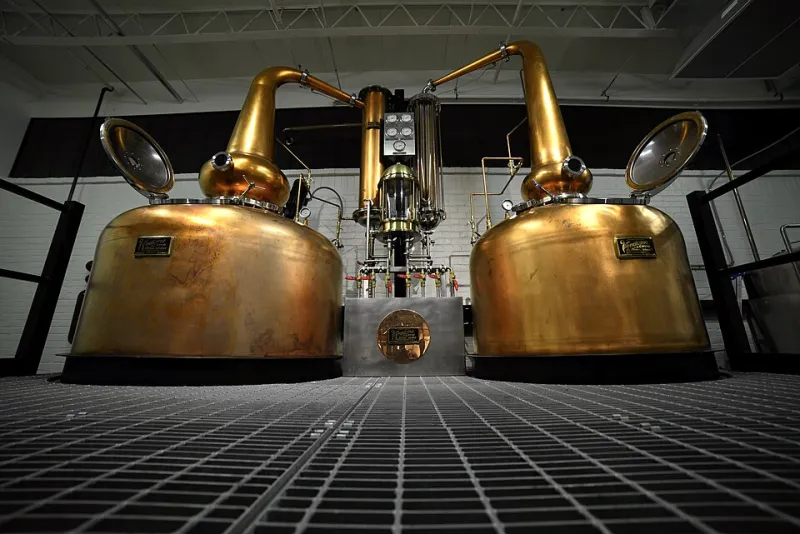
Photo: Thechadwix, CC BY-SA 4.0, via Wikimedia Commons
In 2010, there were fewer than a hundred licensed distilleries operating across the United Kingdom. By the mid-2020s, that figure had risen to well over eight hundred. The transformation has been rapid, disruptive, and — from where we stand at Derbyshire Distillery — deeply encouraging. Something fundamental has shifted in the way British consumers think about what is in their glass, and the established order of the spirits industry is still catching up.
This is not a niche story. It is a structural change in one of Britain's most economically significant food and drink sectors, and it carries implications for producers, retailers, and drinkers alike.
The Giants and Their Limitations
To understand what craft distilleries are reacting against, it is worth considering how the mainstream spirits industry has historically operated. The global market is dominated by a small number of very large corporations — multinationals whose portfolios span dozens of brands, whose production facilities process millions of litres annually, and whose primary obligation is to shareholders rather than to the drinker holding the glass.
This model produces consistency. It produces efficiency. What it does not always produce is character. When a spirit is made at industrial scale, optimised for replicability and shelf-stability across global markets, something is inevitably lost. The idiosyncrasies that make a drink interesting — the geographical specificity, the seasonal variation, the decisions made by a distiller who genuinely cares about this particular batch — are precisely the qualities that large-scale production tends to engineer out.
Consumers have noticed. Not all of them, and not all at once, but in sufficient numbers to constitute a genuine market shift.
Authenticity as a Commercial Force
The appetite for provenance and transparency that has reshaped British food culture over the past two decades — the farm shops, the farmers' markets, the craft breweries on every high street — has now arrived in earnest at the spirits category. Drinkers who will readily pay a premium for a locally sourced cheese or a small-batch coffee are applying the same logic to their gin, their whisky, and their rum.
Research from the Wine and Spirit Trade Association and various independent consumer studies consistently shows that younger British drinkers, in particular, place significant value on knowing where their drink comes from, who made it, and how. They are less susceptible to the inherited prestige of heritage brands and more responsive to demonstrated craft and genuine storytelling. They want to understand the process, not merely consume the product.
This is, in many respects, a more demanding kind of consumer. It is also a more rewarding one to serve.
The Craft Distiller's Competitive Advantage
Independent distilleries like Derbyshire Distillery cannot compete with multinationals on volume, on distribution reach, or on marketing spend. Nor should they attempt to. The competitive advantage of a craft producer lies elsewhere entirely — in specificity, in flexibility, and in the depth of relationship possible between a small producer and its audience.
When we develop a new expression at Derbyshire Distillery, we are not required to pass it through multiple layers of corporate approval or to ensure it will sell in equivalent quantities across forty-seven countries. We can respond to seasonal botanical availability. We can experiment with a single cask. We can take a decision on a Tuesday morning and implement it by Thursday. That agility is genuinely valuable, and it produces spirits that no boardroom-driven product development process could replicate.
There is also the matter of accountability. The people who make decisions about our spirits are the same people who answer questions at tasting events, who respond to correspondence from customers, and who live in the communities in which we operate. That proximity creates a standard of care that is difficult to institutionalise at scale.
The Challenges Are Real
It would be dishonest to present the craft spirits movement as an uncomplicated success story. The challenges facing independent producers are considerable and deserve acknowledgement.
Capital requirements for distillery equipment are substantial. Regulatory compliance — excise duty, licensing, labelling legislation — demands expertise that many small businesses must acquire from scratch. Distribution remains a persistent difficulty; the major supermarket chains and on-trade buyers have established relationships and listing processes that can be difficult for smaller producers to navigate. And the craft spirits market itself has grown crowded, meaning that quality alone is no longer sufficient to guarantee visibility.
Perhaps most acutely, there is the tension between craft and scale. A distillery that succeeds faces the uncomfortable question of how to grow without compromising the very qualities that made it appealing in the first place. There is no universal answer. Some producers choose to remain deliberately small. Others invest carefully in expanded capacity whilst preserving their production philosophy. The decision is consequential, and it is one that every successful independent distillery must eventually confront.
What Comes Next
The British craft spirits sector is no longer in its infancy. It has survived the initial wave of enthusiasm, weathered the economic pressures of recent years, and demonstrated that consumer interest is sustained rather than merely fashionable. The distilleries that have endured are, by and large, those that prioritised quality and authenticity over rapid growth.
The next phase of the sector's development will likely involve greater consolidation — some independent distilleries will be acquired by larger groups, some will close, and others will find sustainable niches that allow them to thrive on their own terms. What will not change is the underlying consumer preference that created this moment: the desire for spirits that mean something, that come from somewhere specific, and that bear the mark of genuine human craft.
At Derbyshire Distillery, that preference is not a market trend to be capitalised upon. It is the founding principle of everything we do.