Shaped by Stone: How the Peak District's Ancient Geology Gives Our Spirits Their Soul
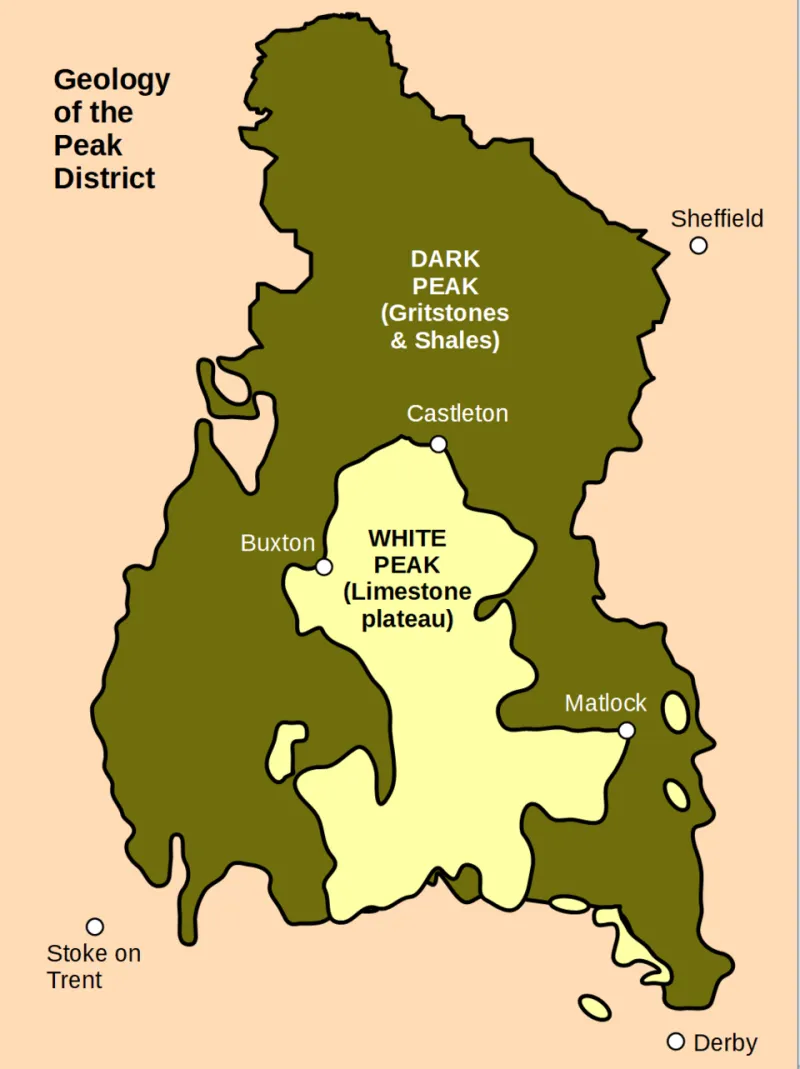
Photo: Douglal, CC BY-SA 4.0, via Wikimedia Commons
There is a French word that wine lovers reach for when they wish to describe something ineffable about a bottle — something that cannot be replicated in a laboratory or engineered by a blending team. Terroir. It speaks to the totality of a place: its soil, its elevation, its prevailing winds, the quality of light that falls upon it in June. For decades, the spirits industry largely dismissed the concept as the preserve of viticulture. At Derbyshire Distillery, we respectfully disagree.
The Peak District is one of Britain's most geologically distinctive landscapes. Beneath the heather and the dry-stone walls, beneath the dales and the dark gritstone edges, lies a foundation of carboniferous limestone laid down some 340 million years ago. It is this bedrock that quietly governs almost everything we do.
What Limestone Does to a Landscape
Limestone is a porous, reactive rock. As rainwater percolates through it over centuries, it dissolves and re-mineralises, emerging in springs and aquifers with a character entirely its own. The water that eventually finds its way into our production process carries trace minerals — calcium, magnesium, bicarbonates — that influence fermentation, affect enzyme activity, and contribute to the mouthfeel of the finished spirit in ways that are subtle but genuinely measurable.
But the geology's influence does not stop at the water table. Limestone landscapes are alkaline environments, and alkaline soils favour particular plant communities. The botanicals that thrive across the White Peak — hawthorn blossom, elder, juniper, wild thyme, and meadowsweet — do so in part because of the chemistry beneath their roots. These are not incidental details. They are the reason our gin tastes the way it does, and why no gin produced three hundred miles away, however carefully made, will taste quite the same.
Microclimate and Maturation
The Peak District sits at elevation. Even in the lowland parishes of Derbyshire, the landscape rises quickly toward moorland plateaux that can exceed 500 metres. This altitude brings cooler average temperatures, higher rainfall, and a humidity that fluctuates meaningfully between seasons. For a distillery concerned with maturation — and we are — these conditions matter enormously.
Spirits aged in our cellars breathe differently than those resting in a warehouse on an industrial estate in the Midlands. The temperature differential between summer and winter encourages the spirit to expand into the wood and contract back out of it, drawing out vanillins, tannins, and colour compounds in a rhythm dictated by the Pennine seasons rather than by any human schedule. The result is a maturation profile that is genuinely of this place.
There is also the question of humidity. A damper ageing environment slows the rate of alcohol evaporation — what distillers call the angel's share — meaning that spirits aged here tend to retain more of their alcohol volume whilst losing some of their harsher edges. It is a trade that the Peak District's climate negotiates on our behalf.
The Botanicals That Only Grow Here
Terroir in winemaking is largely a passive force — the vine absorbs what the soil offers, and the winemaker works with what they receive. At a distillery, there is an additional layer of intentionality. We choose which botanicals to forage, which to cultivate in partnership with local growers, and which to source from further afield. But the starting point is always the landscape around us.
The limestone grasslands of the White Peak are among the most biodiverse habitats in Britain. Species that have been lost from lowland England for generations persist here because the soil chemistry and the grazing patterns have remained relatively undisturbed. We work with foragers who understand these habitats intimately, selecting botanicals at peak maturity and in quantities that leave the landscape undiminished.
Wild thyme from the limestone pavements near Castleton carries a floral warmth that its cultivated counterpart rarely achieves. Elderflower gathered from hedgerows in the Derwent Valley has a honeyed depth that varies perceptibly between parishes. These are not marketing flourishes. They are the observable results of terroir at work.
Why This Matters to the Drinker
One might reasonably ask whether any of this is discernible in the glass. The honest answer is: sometimes clearly, sometimes subtly, but always consequentially. The mineral brightness that characterises our gin — a quality that experienced tasters often describe as clean or precise — is a direct expression of the water chemistry. The gentle earthiness in our aged expressions reflects both the wood and the conditions in which that wood was stored. The herbal complexity of our botanical selection is inseparable from the landscape in which those plants were gathered.
Terroir, in spirits as in wine, is not a guarantee of quality. It is a guarantee of distinctiveness. It is the reason that what we produce at Derbyshire Distillery cannot simply be reproduced elsewhere, even if every recipe, every still, and every cask were transported wholesale to another county. The Peak District is not a backdrop to our work. It is a collaborator — one with 340 million years of experience.
When you next open a bottle from our range, we would invite you to consider the stone beneath the soil, the mineral in the water, and the centuries of geology that conspired, long before any distiller arrived, to make this particular corner of England taste the way it does.