The Tools of the Trade: Inside the Equipment That Defines Every Drop We Produce
Photo: François Bonvin, Public domain, via Wikimedia Commons
A spirit's character is shaped long before it reaches the cask or the bottle. It is determined, in part, by decisions made years earlier — decisions about which still to commission, what gauge of copper to specify, how tall to make the neck, and whether to opt for a worm tub or a shell-and-tube condenser. These are not peripheral technical details. They are, in the truest sense, flavour decisions.
At Derbyshire Distillery, we have thought carefully about every piece of equipment in our production facility. What follows is an account of that thinking — an explanation of what our equipment does, why we chose it, and how it contributes to the spirits you eventually pour.
The Copper Pot Still: Character Begins Here
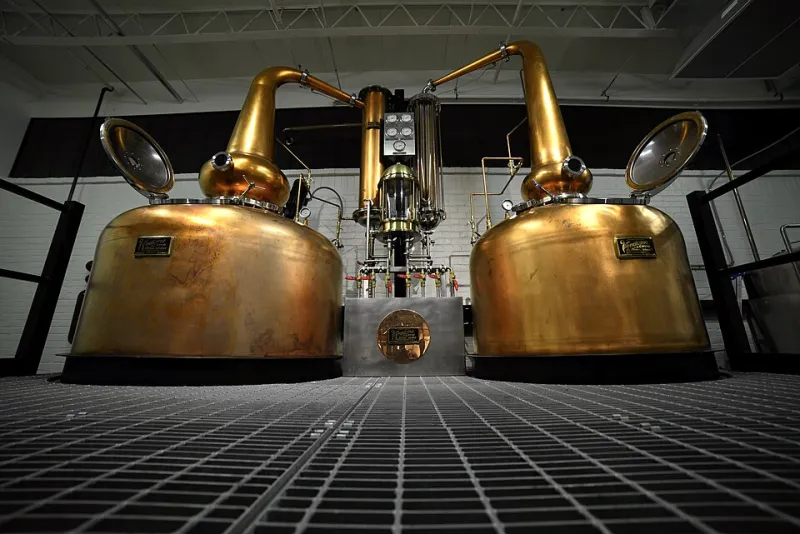
The centrepiece of our distillation hall is a pair of copper pot stills, fabricated to our specification by a traditional coppersmith whose family has been working the metal for three generations. Copper is not simply a material of convention or aesthetic preference. It plays an active chemical role in the distillation process, reacting with sulphur compounds produced during fermentation to strip out undesirable notes — rubbery, eggy, or otherwise harsh — that would otherwise carry through into the spirit.
The geometry of a pot still is equally consequential. A taller, more slender neck encourages reflux — the process by which heavier, oilier vapour condenses partway up the still and falls back into the pot for redistribution. More reflux produces a lighter, more delicate spirit. A shorter, wider neck allows heavier congeners to pass through with less resistance, yielding a fuller-bodied, more robust character. Our stills occupy a deliberate middle ground: tall enough to produce the clarity we prize in our gin, but with sufficient belly and curvature to preserve the weight and texture that distinguishes our aged expressions.
The lyne arm — the angled pipe that carries vapour from the neck to the condenser — introduces further variables. An upward-angled lyne arm encourages additional reflux; a downward angle allows more vapour through. Ours are set at a modest downward gradient, a decision arrived at after extended conversation with our coppersmith and refined through early production runs.
Fermentation: Where Flavour Is Born
Distillers sometimes speak of fermentation as though it were merely a preparatory stage — the means by which sugar becomes alcohol before the real work begins. In practice, fermentation is where much of a spirit's flavour complexity originates, and the vessels in which it takes place have a significant bearing on the outcome.
We ferment in open-topped wooden washbacks made from Oregon pine, a choice that sets us apart from the majority of contemporary distilleries, which favour stainless steel. Wooden vessels are more difficult to clean and maintain, and they harbour microbial communities — wild yeasts and bacteria — that influence the fermentation in ways that cannot be entirely predicted or controlled. This is, for us, a feature rather than a fault.
The slow, extended fermentations that our wooden washbacks encourage — typically running for sixty to seventy-two hours, compared with the forty-eight-hour standard at many facilities — produce a wash rich in esters and other flavour-active compounds. These contribute the fruity, complex notes that characterise our new-make spirit before it has spent a single day in wood. Our production manager, who joined us from a Scotch whisky background, describes the washbacks as the distillery's most important flavour tool — a view that the finished spirit consistently validates.
The Condenser: An Overlooked Variable
If the still is the instrument most associated with distillation in the public imagination, the condenser is its largely invisible counterpart — the component that transforms vapour back into liquid and, in doing so, makes a final contribution to the spirit's texture and temperature profile.
We use a traditional worm tub condenser for our pot still operations: a coiled copper pipe submerged in a wooden tub of cold water drawn from our local supply. The worm tub cools vapour more slowly and less uniformly than a modern shell-and-tube condenser, allowing greater contact time between the spirit and the copper and producing a slightly heavier, more textured new-make. It is a deliberately old-fashioned choice, and one that requires more attentive management — water temperature, flow rate, and ambient conditions all require monitoring — but the character it imparts is, in our view, worth the additional effort.
For our gin production, we employ a separate vapour-infusion basket positioned within the still's neck. Botanicals are suspended here rather than macerated directly in the base spirit, allowing the rising vapour to carry their aromatic compounds through gently and precisely. The basket itself was designed in collaboration with our coppersmith and has been refined over several iterations based on tasting feedback from our distilling team.
Maintenance, Craft, and the Human Element
Equipment of this quality demands skilled custodians. Our head distiller and production team carry out daily checks on all vessels, stills, and pipework, and our coppersmith visits the distillery periodically to inspect the stills for wear, re-solder joints, and advise on any modifications suggested by operational experience.
Copper, over time, develops a patina that speaks to its history of use. It is not merely decorative. The surface chemistry of a well-used still differs from that of a new one, and experienced distillers will attest that stills often improve with age, their surfaces becoming progressively better attuned to the reactions they are asked to facilitate. We regard our equipment not as static infrastructure but as a living part of the production process — one that develops and matures alongside the spirits it helps to create.
Bespoke Over Standard
Perhaps the most significant distinction between an artisanal operation and an industrial one lies not in any single piece of equipment but in the relationship between producer and machinery. A multinational distillery purchases standardised equipment designed for maximum throughput and minimum variance. An independent distillery like ours commissions, modifies, and occasionally invents the tools it needs to achieve a specific result.
This bespoke approach is more expensive and more time-consuming. It requires ongoing dialogue between distillers, engineers, and craftspeople. It occasionally produces failures that must be learned from and corrected. But it also produces spirits that could not have been made any other way — spirits that carry, in every sip, the evidence of considered decisions, skilled hands, and equipment built for purpose rather than for volume.
That, ultimately, is what you hold when you open a bottle from Derbyshire Distillery.